
Turtle Friendly Lighting on Florida Jobs: What Contractors and Distributors Need to Get Right
If you work the Florida coast, turtle lighting is not a specialty niche anymore. It is a permit condition, a city inspection item, and a callback waiting to happen if the wrong fixture faces the beach. Nesting season runs for months. Hatchlings crawl toward the brightest horizon they see. White LED wall packs, unshielded floods, and warm-looking 3000K sources that still leak blue light will pull them inland. The Florida Fish and Wildlife Conservation Commission keeps the rule simple: keep it low, keep it long, and keep it shielded. The work is making that rule survive a real bid, a real warehouse, and a real HOA board.
What the three FWC rules actually mean on a job
Keep it low means the lowest mounting height and the lowest output that still does the safety job. A 26 watt wall pack on a two-story condo stair is often more than the ordinance wants. Field-adjustable amber fixtures matter here because you can hang one catalog number and step the wattage down after the inspector walks the site.
Keep it long means a true long-wavelength source, generally 560 nanometers and up, with no energy below that line. Amber, orange, or red LEDs qualify when they are true amber diodes. Phosphor-converted amber, 2700K warm white, RGB boards, and a gel taped over a white lamp do not. RAB’s amber families use true amber LEDs in that 585 to 624 nanometer window, which is the distinction I walk through at the counter more than any other.
Keep it shielded means full cutoff. No light above 90 degrees. No glowing lens visible from the beach. House-side shields, rotating hoods, and the right mount are part of the product, not extras you add after a failed night inspection. A slipfitter aimed wrong can take a cutoff area light and throw glow toward the dune. Mounting is half the compliance.
The RAB families I specify on coastal work
RAB now puts turtle-friendly amber across the fixture types contractors already hang, which is what makes the line usable. You are not hunting a boutique wildlife catalog. You are staying inside families your distributor can stock.
Heritage covers decorative post-top and wall lanterns on HOA streets, hotel drives, and boardwalks. The house-side shield keeps glow off the beach while the lantern still looks like a lantern. ALED is the area and parking workhorse. Amber ALED models are full cutoff on pole and wall mounts, field-adjustable so you can hold output down, and available with a beach-side shield.
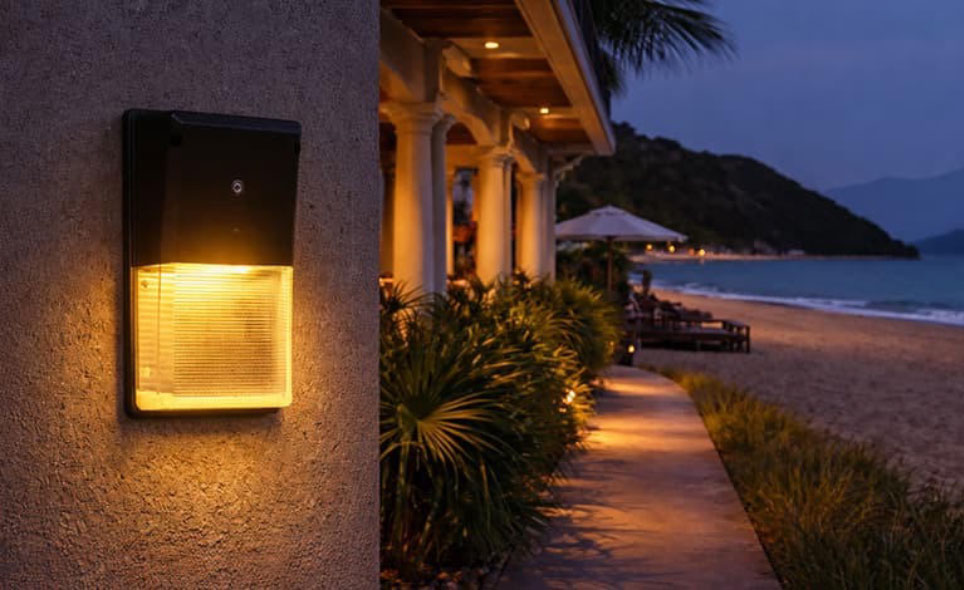
VAN34 handles canopies, covered walks, and drop-off soffits without punching white light toward the water. SLIM is the wall pack I recommend most often for stairs, service doors, and perimeters. SLIM amber runs 12, 18, or 26 watts at 585 to 595 nanometers, full cutoff, and DarkSky certified as a sea turtle sensitive luminaire. The brass finish is the one coastal supers ask for because it holds up in salt air.
WPLEDS and WPLEDM, the LPACK family, fill the compact cutoff wall pack slot. Amber versions sit near 592 nanometers, with selectable wattage and DarkSky plus DLC LUNA listings on the published spec. Small is 6, 10, and 13 watts. Medium is 16, 24, and 32 watts. KAI is the roadway cobra head when a city wants amber on the street side of a coastal property. LF34 is the landscape flood, with a long-wavelength source around 597 nanometers and a rotating hood so you can cut glare off the dune.
A Treasure Coast job that went the long way around
A contractor on the Treasure Coast called after a beachfront condo failed a night inspection. They had swapped old floods for new 3000K LED wall packs and figured warm white would be close enough. It was not. The lenses glowed from the sand. We pulled SLIM amber on the beach-facing elevation, stepped them to the lowest wattage that still lit the stairs, and used LF34 amber floods with the hoods rolled down on the landscape beds. Parking on the west side of the building stayed on standard ALED because that lot has no beach view. That split is the balanced call. Not every fixture on a coastal property has to be amber. Every fixture that can be seen from the nest does.
What distributors should stock, and what they should not promise
The branches that win this work keep a short amber list on the shelf: SLIM, WPLEDS or WPLEDM, one ALED size, VAN34 amber, and a couple of LF34 floods. Heritage and KAI can be quoted to the job. Promising that any amber SKU is FWC certified is how you get a job rejected. Certification sits on the fixture and the install, not on the word amber printed on a carton. Confirm the current FWC certified wildlife lighting list and the city ordinance before the bid goes out. Brevard, Indian River, St. Lucie, Martin, and Palm Beach all enforce this, with nesting windows that commonly run March through October. Puerto Rico coastal work follows the same physics even when the paperwork looks different.
Amber also looks different to the owner. It is not 4000K parking-lot white. Set that expectation early or you will be back with a complaint that the lot feels dim. It is supposed to feel dimmer. That is the point of keep it low.
How we help you bid it once
Bring us the elevation that faces the water, the mounting heights, and the local ordinance, not only a fixture count. UES will help you pick the amber family that matches the application, check cutoff and shields, and keep the rest of the site on standard product where the beach cannot see it. Brandy Ballard on our Florida inside team lives in the RAB line. I am in the field. Turtle lighting is one of those jobs where that split saves a second truck roll.
About the Author
Brett Milton is Lighting Sales Manager for Florida at United Electrical Sales. He works with electrical contractors, distributors, and specifiers on indoor and outdoor LED lighting, including turtle-friendly amber packages for coastal Florida jobs. Brett’s focus is keeping lighting packages practical on the job site, from condo stairs to municipal lots, and making sure the product that gets ordered is the product the crew can hang, shield, and stand behind at inspection.
Connect with Brett Milton on LinkedIn
RAB Lighting line support, Florida inside sales: Brandy Ballard, brandyballard@uesrep.com or 407-781-1739.
Further Reading: